If your lights dim every time the dryer kicks on, or you are still living with a fuse panel, your home’s electrical service is probably working harder than it was ever designed to. Here is how to tell when an upgrade is due — and what actually happens on the day.
Most homes in Burlington built before the 1980s were wired for a very different household. A 60-amp service was plenty when a family ran a fridge, a stove and a couple of lamps. Today the same panel is being asked to carry a heat pump, an induction range, a hot tub and an EV charger — and it simply does not have the headroom.
Signs your panel is past its limit
You rarely get one dramatic warning. It is usually a pattern of small annoyances that build up over months:
- Breakers that trip regularly — especially on the same circuit, or when two appliances run together.
- Lights that dim or flicker when a large appliance starts up.
- Warm or discoloured breakers, or a faint burning smell near the panel.
- A fuse panel instead of breakers, or a brand no longer supported by parts.
- No room left — every slot is full and you need a new circuit.
A panel is the only part of your electrical system that every circuit passes through. When it fails, nothing else in the house matters.— Brant Electric Limited
What an upgrade actually involves
An upgrade is more than swapping a box on the wall. The service entrance, meter base, grounding and often the utility connection all get touched. A typical residential job runs like this:
- Load calculation — we work out what your home draws now and what you are planning to add, then size the new service accordingly.
- Permit and utility coordination — the ESA permit is pulled and the disconnect is scheduled with the utility.
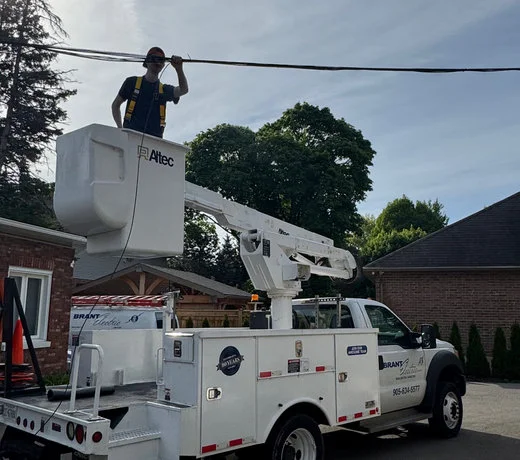
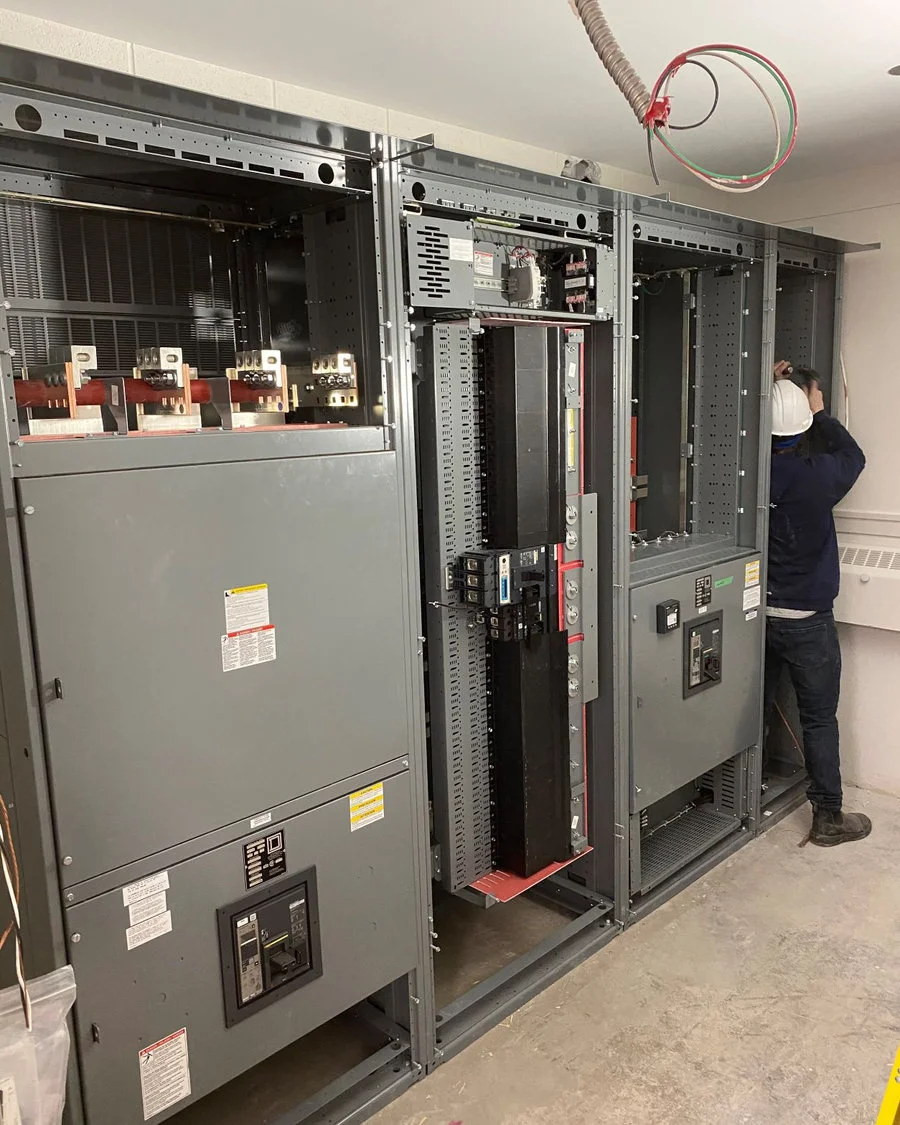
- Cut-over day — power is down for a few hours while the old panel, meter base and service mast come out and the new gear goes in.
- Circuit transfer and labelling — every circuit is moved across, tested and clearly labelled on a new schedule.
- Inspection — the ESA inspector signs off and the utility reconnects.
How long will the power be off?
For a straightforward residential change-over, expect the power to be down for most of a working day. If the service mast and meter base are being replaced as well, plan for a full day. We confirm the window before we start so you can make arrangements.
Choosing the right service size
Bigger is not automatically better — but under-sizing today means paying twice. This is the rough guidance we work from:
| Service size | Typically suits | Headroom for EV / heat pump |
|---|---|---|
| 100 amp | Smaller homes, gas heat and range | Limited — often needs load management |
| 200 amp | Most detached homes | Comfortable for one EV plus electric heat |
| 400 amp | Large homes, shops, multiple EVs | Ample |